The beauty of reflected light in night photography
Part of a multi-page article: Painting with light on Puglia's crystal waters
Article Sections
- The beauty of reflected light in night photography
- Capturing stillness: the technical challenge of photographing on Puglia's sea
- Beyond color: light-painting in black and white
Reflections as creative material
When light meets still water, something fundamental shifts in my work. It's not simply about capturing a light trail in darkness. It's about harnessing the water's reflective property to amplify compositional power.
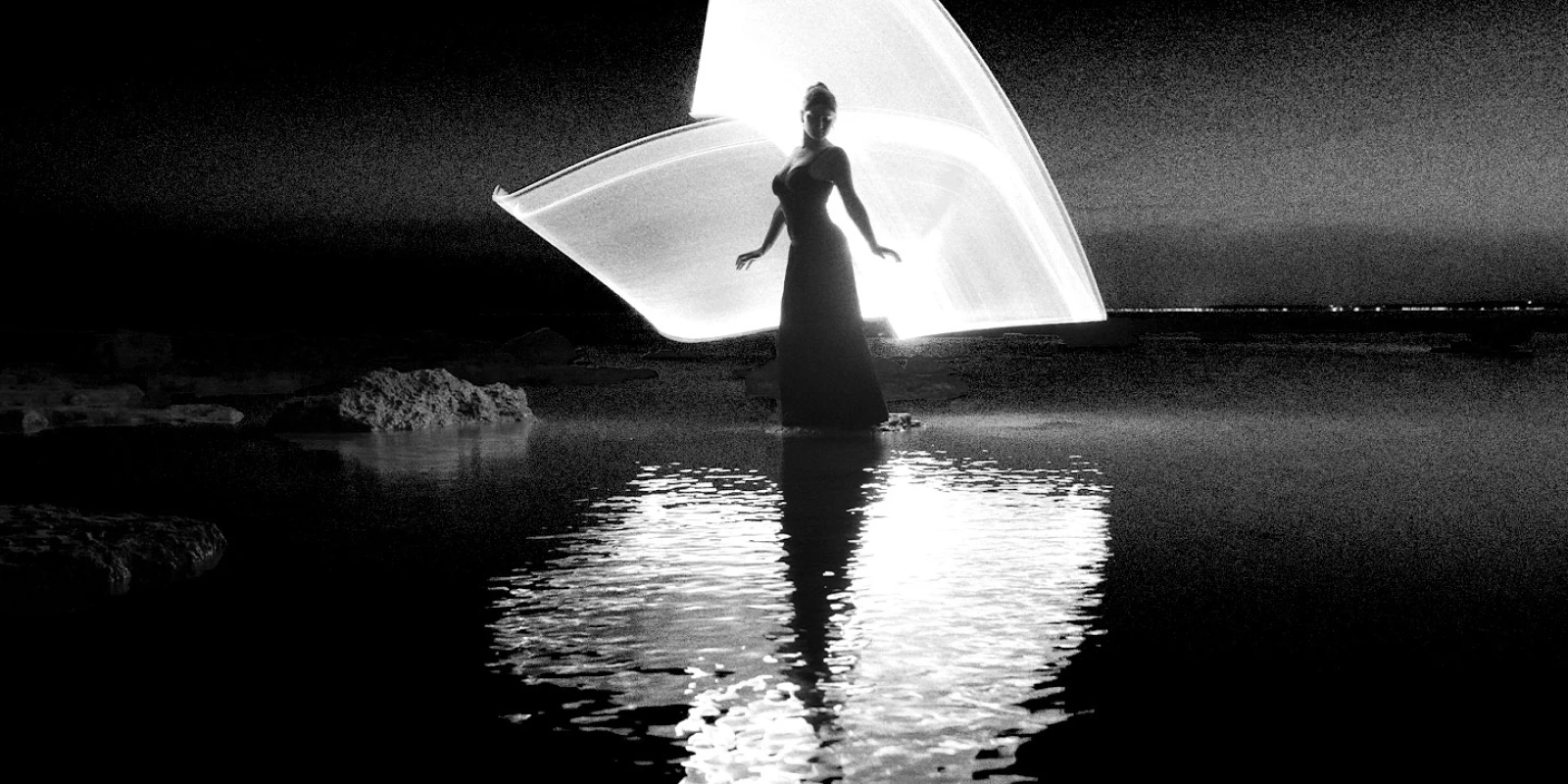
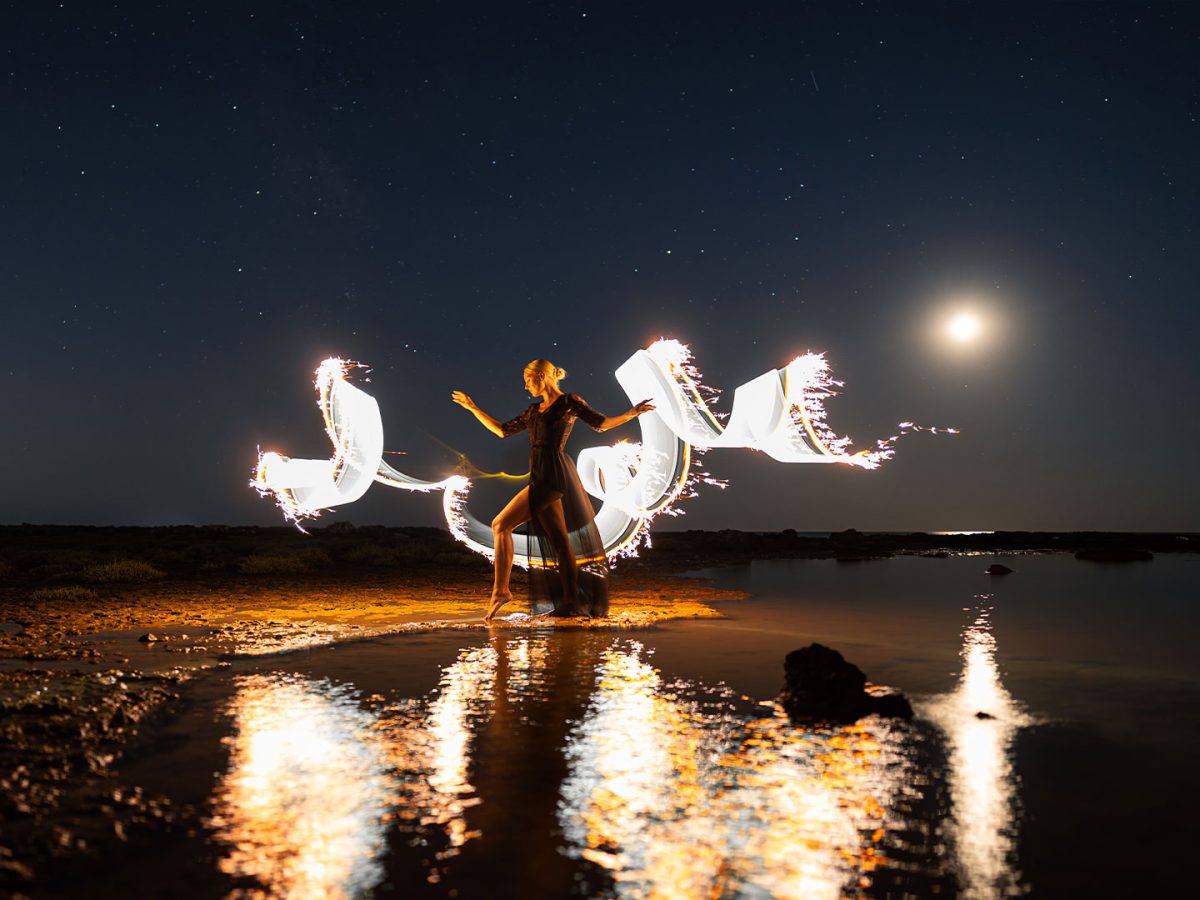
Consider what happens physically: a stroke of light painted into the air during a long exposure becomes, through the water's mirror, an entire geometric form. What was a singular gesture becomes doubled, extended, given new dimensionality. The viewer's eye moves not just across the frame, but down into it, following the reflection's descent into the water's surface.
This doubling effect isn't decorative. It fundamentally alters how the composition reads. A left-to-right movement in the upper half of the frame gets answered by a mirror movement below. This creates an inherent visual logic that feels balanced without being static, harmonious without becoming predictable.
The discovery of symmetry
Years into this practice, I began noticing which reflections held the most visual power. Not all reflections are equal. Some feel accidental, as though the water simply caught whatever happened to be there. Others resonate with an intentional geometry, a sense that the composition was designed to exploit the mirror's properties.
The strongest images share a quality: they use symmetry not as the entire concept, but as an anchor. The reflected light provides a visual foundation, a grounding element that makes the entire frame feel deliberate.
Translucence and depth illusion
There's also a phenomenon I struggle to describe without resorting to abstraction: the reflections create an illusion of translucence. The water becomes neither fully opaque nor transparent, but something between. The light seems to contain depth, as though the painted form extends both above and below the surface simultaneously.
In monochromatic processing, this effect intensifies. The gradations of grey that might be subtle in color become pronounced in black and white. The movement between the brightest light and the darkest shadow gains visual weight.
Why reflections matter for composition
For a photographer working primarily in nocturnal conditions, reflections solve a persistent compositional challenge: how to fill a frame dominated by darkness without resorting to busy foreground details or cluttered secondary elements.
The reflection offers a solution embedded in physics. It provides visual content without artificial intervention. It doubles the visual real estate of the composition using only the laws of optics.
This matters practically. In night photography, simplicity usually strengthens the final image. Reflections preserve that simplicity while multiplying compositional sophistication.
The interplay between light and its mirror image across water remains the most reliable way I've found to create images that hold visual and emotional weight without relying on color, complexity, or external narrative.