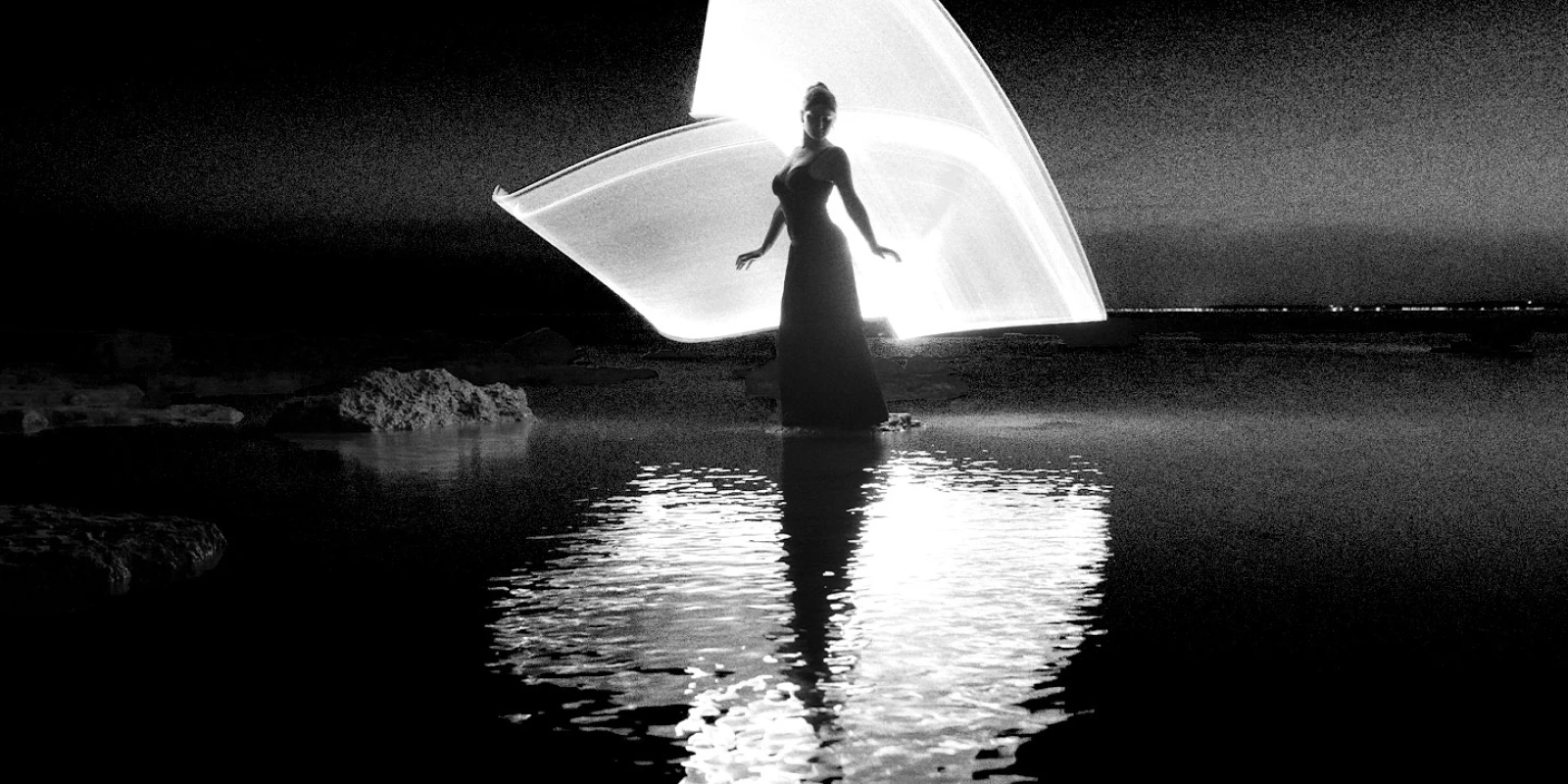
Beyond color: light-painting in black and white
Part of a multi-page article: Painting with light on Puglia's crystal waters
Article Sections
- The beauty of reflected light in night photography
- Capturing stillness: the technical challenge of photographing on Puglia's sea
- Beyond color: light-painting in black and white
The abstraction of monochrome
Many photographers convert to black and white for historical reasons or stylistic convention. For me, monochromatic processing emerged from necessity. Necessity became preference. Preference evolved into conviction.
When I first worked with light-painting on Puglia's nocturnal waters, color felt essential. The vibrant hues of my handheld strobes, the artificial color temperature of LED sources, the way different colors interacted with the night sky—all seemed foundational to the work.
But accumulated experience revealed something unexpected. The color became secondary. What remained constant, what gave the images their power, was the relationship between light and darkness, between the painted gesture and its reflection, between the subject and the surrounding void.
Removing color didn't diminish these elements. It clarified them. The monochromatic palette forced viewers' attention to where it mattered most: the compositional structure, the tonal relationships, the geometric truth underlying the image.
Technical monochromatic conversion
Converting color captures to black and white isn't simple desaturation. It's a process demanding specific choices about how different tonal ranges translate into grey values.
In my work, the lit portions—the painted light—require preservation of their luminous quality. In RGB to monochrome conversion, how much weight goes to the red channel versus green versus blue significantly affects the brightness of the original colored light.
The darker portions demand equally careful handling. A night sky that appears uniform to the naked eye contains subtle tonal information. Aggressive contrast adjustment might crush shadow detail. Preservation of shadow nuance, though, risks flattening the image into visual insignificance.
I rarely push contrast to extremes. Instead, I aim for fidelity—allowing the conversion process to respect the original tonal structure while emphasizing the contrast between light and darkness naturally present in the original capture.
Geometric abstraction through monochrome
Black and white processing reveals something fundamental about these images: their underlying geometry. When color vanishes, the pure structure behind the composition becomes undeniable.
The symmetry created by reflections becomes starkly visible. A light form with its perfect mirror image below suddenly reads as geometric abstraction. What felt like a photograph of a moment becomes something closer to a formal geometric composition.
This abstraction isn't intellectually distant from the original work. It's a clarification of intentions. The light-painting was always fundamentally geometric—a mark-making process using controlled tools to create specific forms. Monochromatic processing reveals that truth.
Individual works in monochromatic series
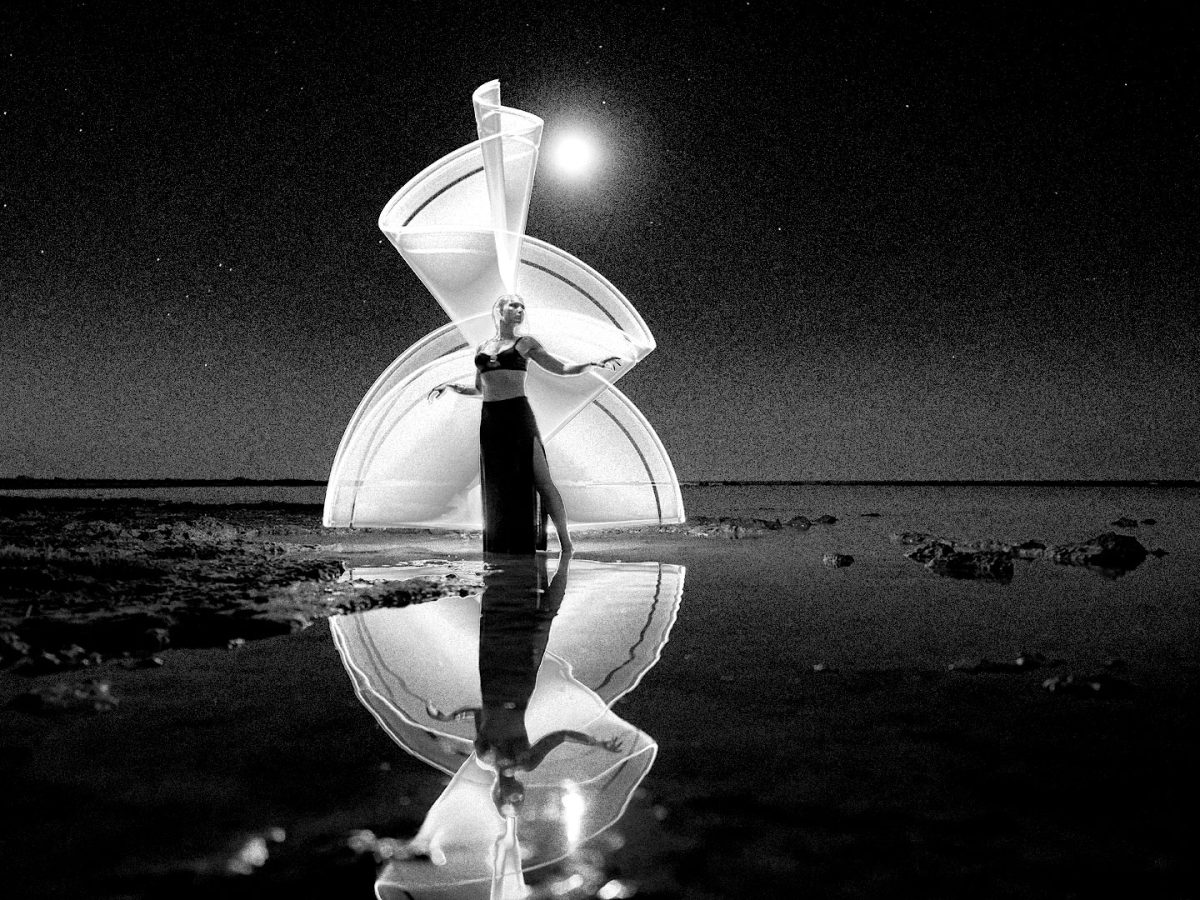
Squared ribbon under moonlight with Clarissa
In this image, captured as the moon had risen barely an hour before, the geometric clarity of the squared light ribbon becomes absolute in black and white. Clarissa's form, rendered almost as silhouette, anchors the composition. The moon's brightness, subtle in color, creates significant tonal variation in monochrome, adding unexpected dimensionality to the nocturnal sky. The water, acting as a perfect mirror, doubles the geometric form with pristine clarity.
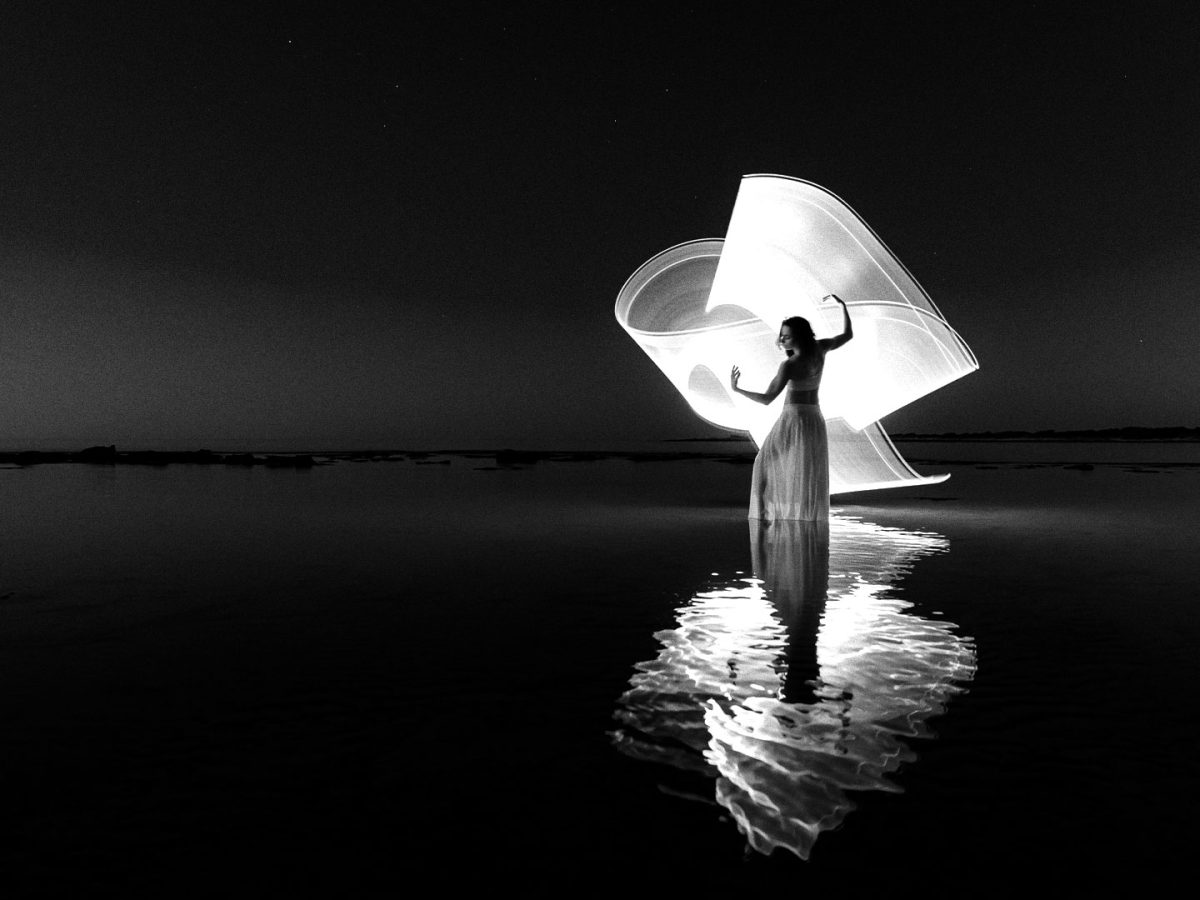
Ribbon in blue hour with Cristina
The liminal moment of the blue hour creates a gradient in the sky, brighter towards one horizon, darker towards the other. Rendered in black and white, this gradient becomes pronounced, framing Cristina's silhouette with architectural precision. The elegantly simple ribbon of light, though unadorned in form, gains sculptural weight in monochrome. Cristina's pose carries an almost classical quality when freed from color distraction.
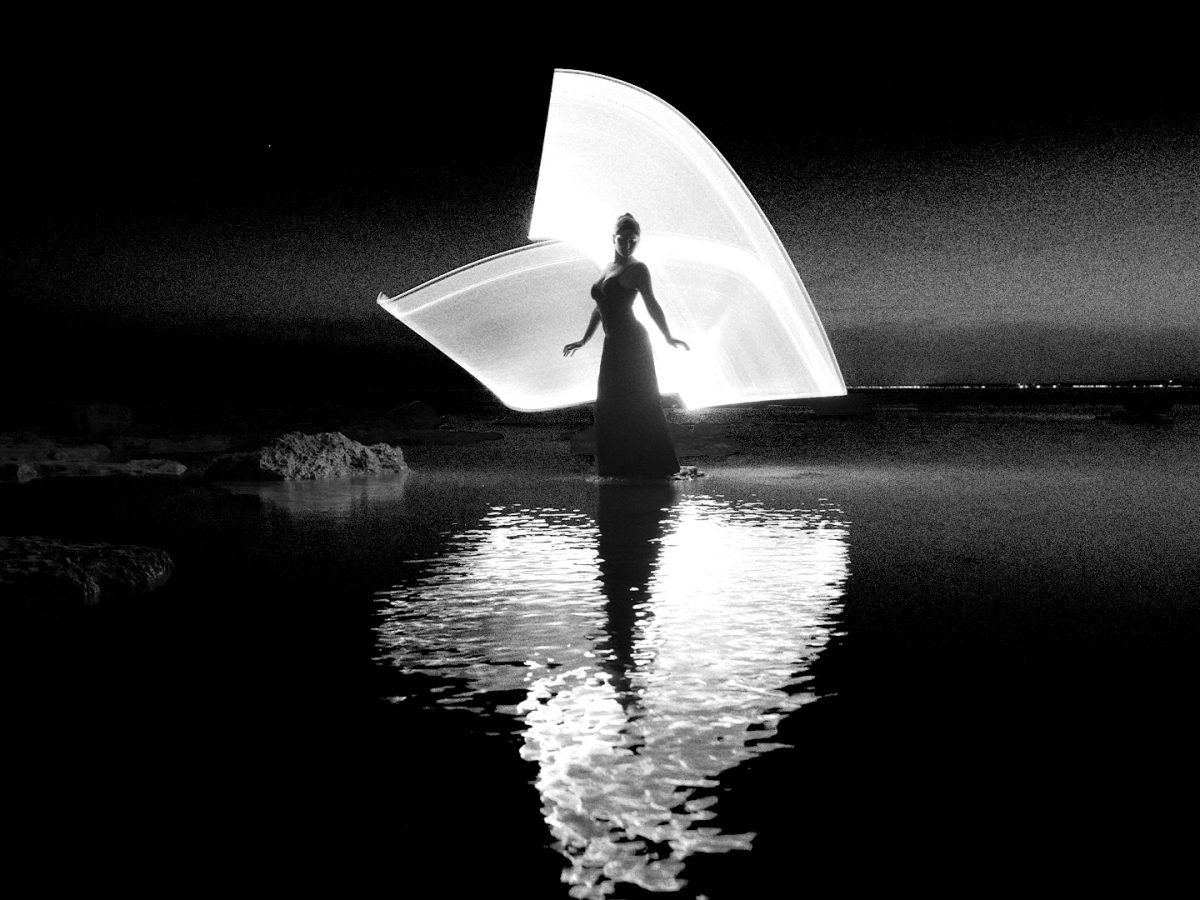
U-shaped embrace with Paola
The exceptional clarity of the Adriatic waters that night preserved every detail of the U-shaped light form and its reflection. In black and white, this precision becomes almost surreal. Paola's figure, gently held within the light embrace, gains compositional weight equal to the light itself. The water's clarity, visible as subtle tonal differences in the reflection, confirms the precision of the original capture. This image demonstrates how technical excellence in original capture becomes invisible quality in monochromatic conversion.
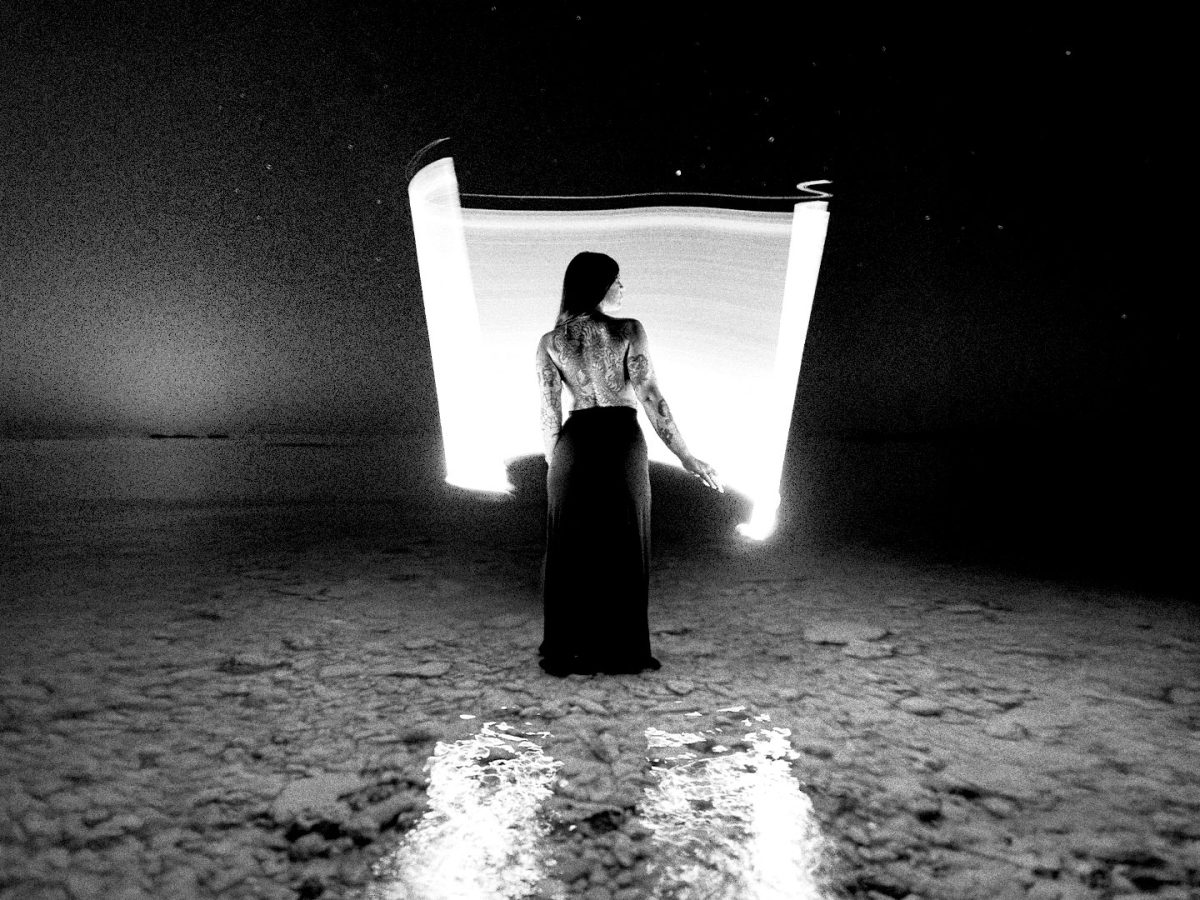
Light fountain under moonlight with Carla
Among the most graphic of the series, this image showcases Carla's elegant pose against a fountain of light bursting upward. Her black attire, in color a stark choice, becomes an integral compositional element in monochrome. The light fountain, rendered in brilliant white against deep grey tones, creates an almost violent contrast that pulls the viewer's eye. The moon high overhead cast sufficient light to illuminate the surrounding landscape without overwhelming the painted light.
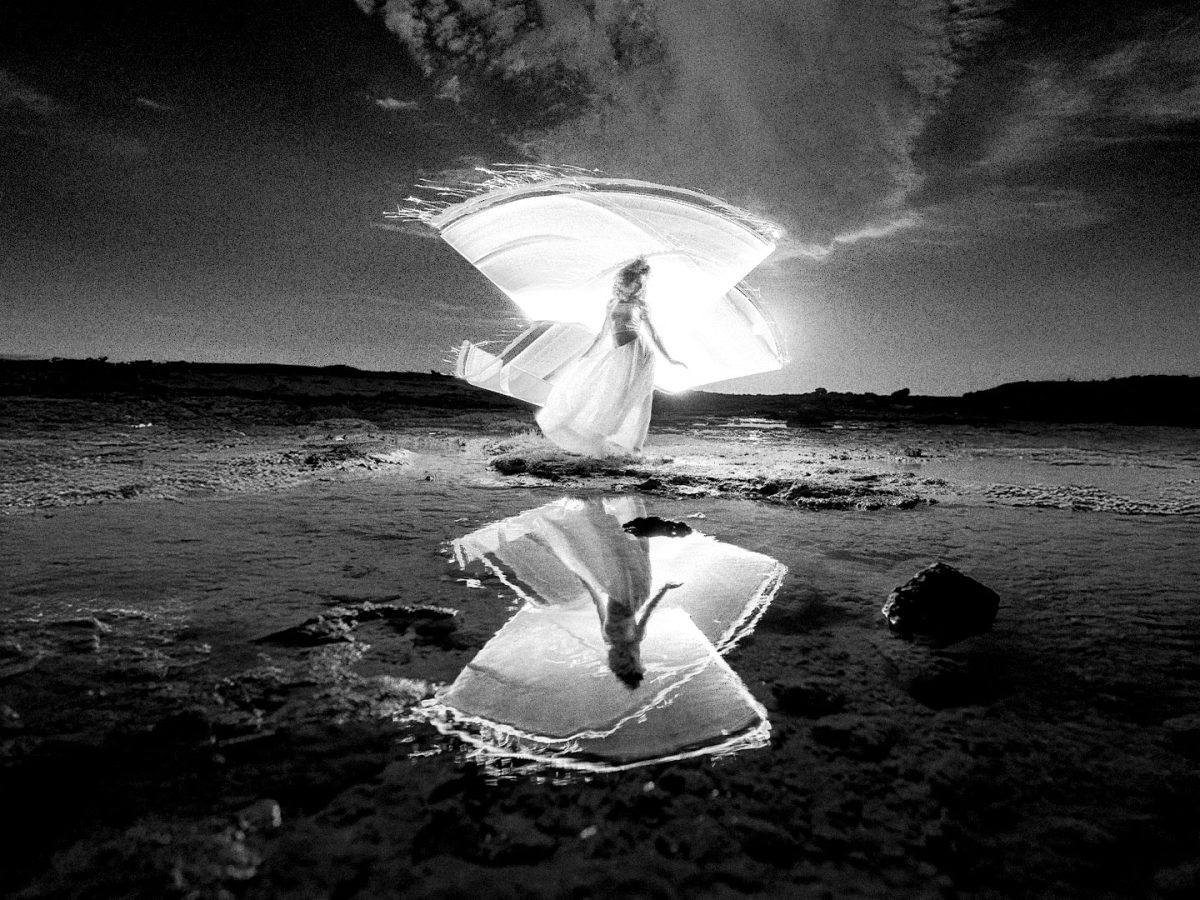
White dress and enhanced ribbon amid wind with Federica
Wind conditions that night moved clouds across the sky and created complexity in water ripples. Yet Federica's white dress seemed to glow, merging visually with the squared light ribbon I had painted. In black and white, the dress becomes nearly indistinguishable from the light itself at certain points. The foreground contains dark rocks that add textural complexity to the composition. The wind-driven water surface, which could have compromised the reflection, instead created an additional layer of visual interest without destroying the clarity of the mirrored form.
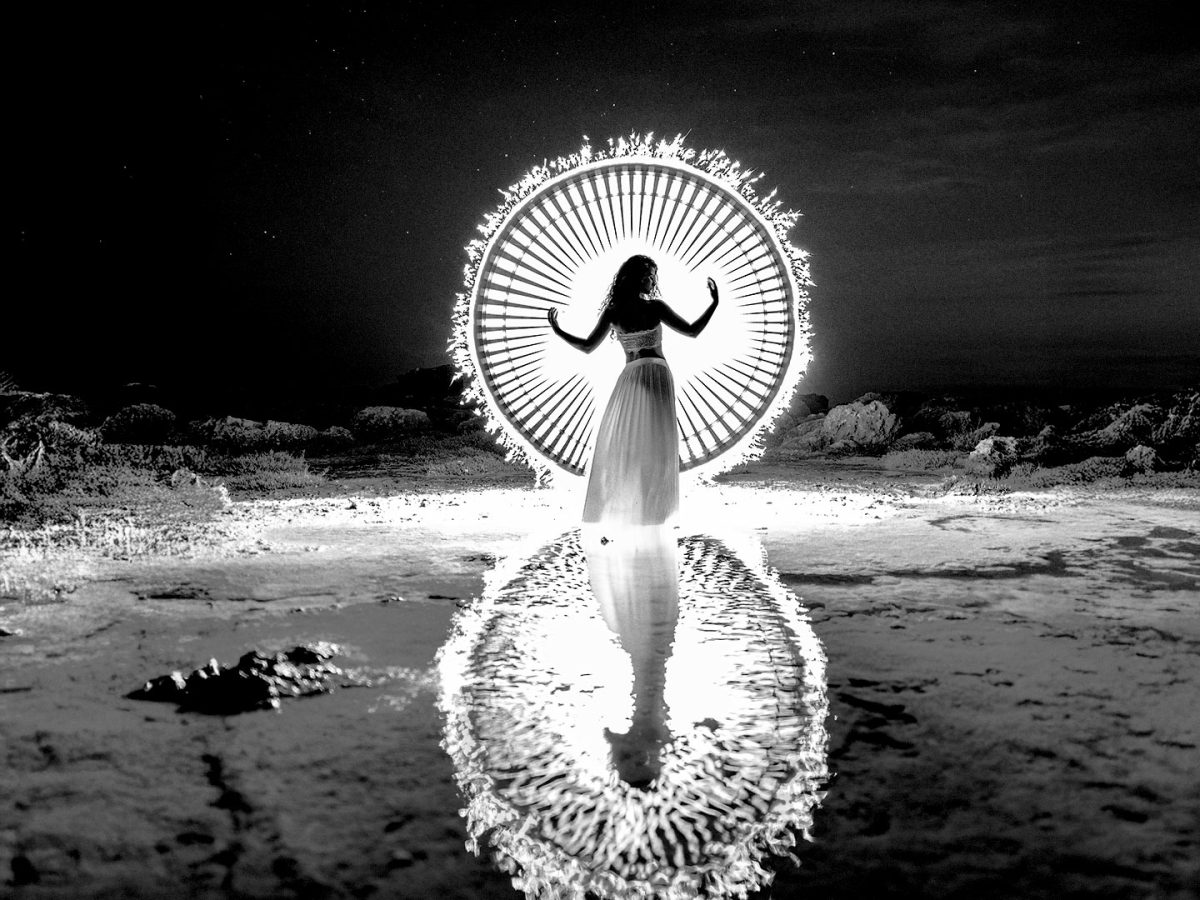
Radial circle with sparks and Sara
This final image demonstrates the most technically complex light-painting setup: a strobed circular form combined with sparks from a handheld sparkler, creating radiating patterns around Sara's form. Elevated ISO captured not just the light painting but surrounding starlight, adding texture to the black void. In monochromatic conversion, the intricate patterns of light trails become the image's primary focus. The geometric complexity, barely visible in color, becomes the organizing principle of the monochromatic interpretation.
The clarity of restraint
Working extensively in black and white taught me something about light-painting I hadn't fully grasped before. The medium isn't defined by its capacity for color. It's defined by humanity's capacity to control and sculpt light through technique and intention.
Removing color shifted the conversation from what colors I used to what fundamental forms emerged when light met darkness. From there, clarity followed. The symmetry created by reflected light. The geometric precision possible with controlled tools. The compositional strength of simplicity.
These are the lessons monochromatic work revealed. They've shaped my approach to color work as well. I began asking: if I removed all color from this image, would the core composition still compel? If the answer arrived slowly, it suggested additional refinement was necessary.
Black and white photography isn't a simplification of light-painting. It's a clarification. It asks the essential question: what remains when all decoration vanishes? In the strongest images, surprisingly little vanishes. The work holds its weight regardless.
Interested in exploring light-painting further?
I regularly update my creative process insights, technical breakdowns, and new series on my platforms. For those curious about commissioning a light-painting experience or exploring the artistic possibilities in their own creative practice, my services page outlines available options.
Follow my ongoing work on Instagram, YouTube, and TikTok to stay connected with new projects and behind-the-scenes documentation.
For direct inquiries about bookings, commissions, or creative collaborations, the contact page remains the best avenue.
Andrea, Sublument